
An Obsessive Mind
Ronald Beiner’s Radical Right Ideologues in the Age of Trump

2000 words
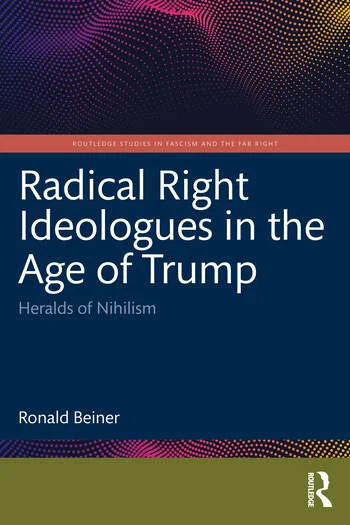
Ronald Beiner’s Radical Right Ideologues in the Age of Trump: Heralds of Nihilism (New York: Routledge, 2026)
Ronald Beiner and I go way back. In 2018, Beiner published Dangerous Minds: Nietzsche, Heidegger, and the Return of the Far Right, which I reviewed at Counter-Currents.[1] Beiner’s book warns academics that it is dangerous to teach Nietzsche and Heidegger because they are profoundly illiberal thinkers who will corrupt the youth. As exhibits, he points to such Right-wing luminaries as Richard Spencer and Alexander Dugin.
Beiner’s solution, however, is to encourage academics not to whitewash Nietzsche and Heidegger but to expose the full measure of their anti-liberalism. He seems to think that illiberal ideas are self-evidently false. Thus professors simply need to point at their heresies and indignantly splutter about fascism.
I thought this very naïve. For one thing, how does Beiner explain people like Spencer and Dugin? They didn’t become who they are because they were reading whitewashed liberal accounts of Nietzsche and Heidegger. In fact, they were probably convinced by an earlier generation of Beiners, since there are quite a few such academic unmaskers: e.g., Geoff Waite, Domenico Losurdo, Richard Wolin, Emmanuel Faye. It is easy enough to ignore such moralizing and simply focus on the “dirt” they dig up.
Thus, even though I disagreed with Beiner’s agenda, I recommended Dangerous Minds as a creditable introduction to anti-liberal themes in Nietzsche and Heidegger. I thought Beiner could help create new Right-wing Nietzscheans and Heideggerians. Certainly if I had read it as an undergraduate it would have sped along my intellectual development.
When Beiner read my review, he seemed stung by it. Not by my criticisms, mind you, but by my praise: “the first off the mark in reviewing the book was a prominent radical-right intellectual named Greg Johnson. He wrote a long review of the book that was intellectually serious and also entirely upfront about his own repellent political commitments.”
My review wrung a reply from Beiner with the snarky title “When Neo-Nazis Love Your Book” in the Chronicle of Higher Education.[2] (Amusingly, it is still behind their paywall.) But did Beiner deal with my arguments? No, there was a bit of inconclusive handwringing—then he simply reprised his book to promote it to his fellow professors.
Eight years later, Radical Right Ideologues begins with a Preface: “Where the Author Lays Out his Anxieties about Publishing this Book.” There’s more handwringing but no more insight. “As goes without saying, the notion that anything that I write could help to recruit people into political tendencies that I abhor is almost a compelling reason to lay down my pen.” Yet he continues to write.
Does this mean that Beiner has a solution to the problem I raised? The solution is actually quite simple: to show that the radical Right is wrong. But that’s out of the question for Beiner. It would require actual intellectual dialogue, which would require civility, and that’s a bridge too far:
One can’t pretend that engaging with such figures is the same as engaging with other intellectual interlocutors. “Dialogue” with a Greg Johnson or an Alexander Dugin or a Bronze Age Pervert unavoidably helps to legitimize them, which is not only quite painful but politically perilous.
The real risk that Beiner cannot countenance is that genuine intellectual dialogue requires entertaining the possibility that one might change one’s own mind, i.e., the possibility that one might be wrong.
Since Beiner can’t actually engage his enemies, he must simply continue to point and splutter, with all the dangers that entails:
This yields a sobering reflection on the risks of engaging intellectually with the far right, since it has elements of a lose-lose proposition: we lose if we ignore the far right, because we leave their views unchallenged; and we lose if we engage with the far right, because we give them the attention that they so ardently crave.
Surely not every intellectual debate is a lose-lose proposition. Indeed, normal intellectual debates are win-win propositions, for if one “wins,” one is proven right, and if one “loses,” one still wins by discarding false ideas. Personally, I would be delighted to be proven wrong, as I was many years ago when I was freed from the delusions of classical liberalism.
Maybe Leftists can only lose because they are wrong and wish to cling to their delusions.
Given his terms, Beiner can’t rationally justify writing another book on the Right, so he simply admits to irrational motives:
In the end, how does one weigh up the pros and cons of writing about the people surveyed in my book, and hence giving them air time that might be to their advantage? I confess that I really don’t know. If I were to be fully honest about it, I would have to say that I have written these essays more as a kind of compulsive behaviour—because of my obsession with these figures—than as a fully reasoned-out calculation of good effects, since the possible bad effects are substantial, and quite possibly exceed the good effects. Hence engagement with the radical right entails real risks that cannot be circumvented. Extremists love attention, believing that it helps them win more recruits to their cause. They may well be right in thinking that. But what choice do we have?
Actually, Beiner does have the right to remain silent. He chooses not to exercise that right, basically, because he’s highly triggered by Trump.
But that’s no argument. If Trump is every bit as bad as Beiner says, and Trumpism really is nourished by the radical Right (which it is), then merely repeating without refuting radical Right ideas can only make matters worse, from Beiner’s own point of view. Yet he continues to write, basically because he chooses to indulge his own obsessions.
I’m perfectly content if Typhoid Ronnie spreads our memes through academia. But it seems a waste of his considerable intellectual talents. Because, again, I would be delighted to be proved wrong.
The Nietzsche Question
Beiner’s book falls into two parts. The first is entitled “Nietzsche as an Essential Resource for the Radical Right.”
It begins with an expanded version of Beiner’s Chronicle article under the title “Can a Liberal Education Create Enemies of Liberalism?” which deals with Nietzsche among other things. (This is the third time it has been published, and it still refers to Counter-Currents as “Cross-Currents“ in one spot.)
It is followed by two essays on Nietzsche: “What Contemporary Radical Rightists (Rightly) Draw from Nietzsche” and “Transversal Racialization: Losurdo’s Account of What Is and Isn’t Proto-Fascist in Nietzsche,” on Italian Marxist Domenico Losurdo’s monumental tome, Nietzsche, the Aristocratic Rebel: Intellectual Biography and Critical Balance-Sheet.[3]
These are the best chapters of the book.
First, Beiner argues that Nietzsche was deeply anti-democratic and anti-modern. Second, Beiner argues that Nietzsche’s proposed alternative was a return to a society of hereditary castes ruled over by warrior aristocrats who would not hesitate to exterminate vast numbers of inferior humans. Third, Beiner points out that Nietzsche was a “post-truth” thinker, meaning that he puts relativity above objectivity and myth above facts. Ultimately, he puts will above everything.
I find Nietzsche’s critique of modernity compelling. Basically, he holds that to flourish human beings need edifying, normative institutions, which in turn require a closed cultural horizon. Modernity leads to decadence by opening these horizons and replacing edifying institutions with freedom of choice.
For me, the solution is to return to classical philosophy, meaning: Socrates, Plato, and Aristotle. This does not appeal to Nietzsche because philosophically he is very much a modern who believes in the power of the will to create values, whereas Socrates, Plato, and Aristotle believed in an objective moral order.
Nietzsche’s solution is basically to go back to the Bronze Age. Frankly, I find this revolting. The worst parts of what I call the Old Right—basically, National Socialism and other interwar fascisms—come from the spirit of Nietzsche: a combination of Bronze Age archaism and the modern nominalist metaphysics of will, which gave rise to modern technocracy, including totalitarianism.
This is why we need a New Right, which is genuinely post-modern, post-technocratic, and post-totalitarian. At his best Nietzsche shows the problems with modernity. Heidegger, however, came to realize that Nietzsche was still imprisoned in modernity’s metaphysics of will. Heidegger offered a better way to return to the Greeks. Heidegger had issues with the metaphysics of presence in Plato and Aristotle, but for me their political thinking remains a valid alternative to modern liberalism.
A Gallery of Straw Men
The second part of Beiner’s book is entitled “Rogues Gallery.” It consists of polemics against Steve Bannon, Alexander Dugin, Jason Jorjani, and Bronze Age Pervert (Costin Alamariu).
I don’t take any of these figures seriously, particularly Bannon. To my surprise, however, Beiner ferreted out something I had forgotten I had said about Bannon:
Bannon is a civic nationalist. We’re racial nationalists. There are overlaps but disagreements on fundamental values. But Bannon is not stiffing us because his life is an experiment. He’s living as if the future he is fighting for has already arrived: a world where the Left has no power . . . Bannon wants to win and actually roll back the Left. That makes him a radical and revolutionary conservative.[4]
I still like that about Bannon. We should all live as if we don’t need to care about the opinions of Leftists.
Why does Beiner focus on a gaggle of pseudo-intellectual buffoons? For the same reason he focuses on the worst aspects of Nietzsche and his legacy: this book is a smear job. His goal is to refute the Right by criticizing its weakest figures rather than its strongest ones. He’s torching straw men.
Several times, Beiner mentions my “Notes on Heidegger and Evola”[5] where I make the point that after his break with National Socialism, Heidegger created the template for what became the New Right. But it doesn’t suit his purposes to deal with the New Right. For instance, he only mentions Alain de Benoist in passing.
I am mentioned in passing throughout the book, seldom in a flattering light. Beiner likes to smear me as a “Nazi,” which is untrue. From his point of view, I might be even worse than a Nazi, because although I don’t agree with National Socialism and other forms of the Old Right, I at least regard it as a serious worldview, whereas I regard contemporary liberal democracy as a joke.
My colleague John Morgan is mentioned dismissively in passing. Michael Millerman, who has a good mind despite his baffling affection for Dugin, is mentioned several times, primarily because Beiner knew him personally. But the rest of the time, Beiner is content to focus on clowns.
I stand beside my positive review of Dangerous Minds. But I cannot recommend Radical Right Ideologues in the Age of Trump. It is shallow, shrill, and ridiculously overpriced: around $50 for a paperback of 160 pages.
Beiner's subtitle declares radical Right ideologues “heralds of nihilism” because, like the Joker, we “just want to watch the world burn.” But that’s not nihilism as I understand it.
Nihilism doesn’t refer to destruction or negation as such. It refers to the destruction of the highest values. Moreover, at least in Nietzsche’s view, the highest values of Christian civilization were not destroyed by people like Nietzsche. Instead, they destroyed themselves due to their own internal contradictions.
I feel the same way about the Left liberalism that Beiner defends. It is in the process of destroying itself because it is based on falsehoods. It is not nihilism to wish to dynamite the ruins, clear the ground, and build anew.
It isn’t nihilism if nothing deserves to survive.
Counter-Currents, February 26, 2026
[1] Greg Johnson, “Ronald Beiner’s Dangerous Minds,” Graduate School with Heidegger (San Francisco: Counter-Currents, 2020).
[2] Ronald Beiner, “When Neo-Nazis Love Your Book,” Chronicle of Higher Education, The Chronicle Review, July 6, 2018, pp. B4–B5.
[3] Domenico Losurdo, Nietzsche, the Aristocratic Rebel: Intellectual Biography and Critical Balance-Sheet (Chicago: Haymarket Books, 2021).
[4] Thomas J. Main, The Rise of the Alt-Right (Washington, DC: Brookings Institution Press, 2018), pp. 212 –13.
[5] Greg Johnson, “Notes on Heidegger and Evola,” Graduate School with Heidegger.